Read the transcript
The transcript has been formatted and lightly edited for clarity and readability.
Kelsey Young, Artemis II Lunar Science Lead and Artemis Science Space Flight Operations Lead:
When I first got this role for Artemis II years ago, we started to think about, really, how do we prioritize the science that we can accomplish with this mission? It was the first time that that crew had flown this vehicle. But we really had a vantage point of the Moon that the Apollo astronauts did not have. They were much, much closer to the Moon—which has other advantages—but we had this whole-disk view, this really unique opportunity on the lunar far side where we had never had human eyes before.
Introduction:
Welcome to Notre Dame Stories, the official podcast of the University of Notre Dame, where we push the boundaries of discovery, embracing the unknown for a deeper understanding of our world.
Jenna Liberto, Host:
Alumna Kelsey Young ’09 is NASA’s very first science officer. She was the lunar science lead for the Artemis II mission and talked directly to the crew as they observed the Moon. She recently returned to campus to share more about her work with students and the community. We talked to her about the mission, including the surprising dataset she was most interested in.
Hi, Kelsey.
Kelsey Young:
Hi.
Jenna Liberto:
Thanks for joining me.
Kelsey Young:
Thanks for having me.
Jenna Liberto:
Tell me what your last few weeks have been like.
Kelsey Young:
It’s hard to—I mean, honestly, this sounds very cliché. It’s very hard to put into words. It’s been quite an insane and busy several weeks. With, I mean, of course, being there for the launch, experiencing the mission the way that I did, and then going home and spending some time with family. It’s been a really crazy and fun few weeks.
Jenna Liberto:
Explain what you do for NASA, and what was your role as it relates to the Artemis II mission.
Kelsey Young:
So my day job at NASA is for Artemis, which is, you know, our agency’s series of missions to send humans to the Moon. I am our science flight operations lead. So I’m responsible for integrating science into operations.
And then for Artemis II, I was fortunate to kind of wear two hats. The sort of ops lead role hat that I play on all Artemis missions, plus the lunar science lead for the mission. It was really an honor.
Jenna Liberto:
And so I understand that you’re a science officer, and that’s a relatively new role at NASA. What came to be that that’s now something we need?
Kelsey Young:
It is not relatively new; it is brand-new.
Jenna Liberto:
Are you the first?
Kelsey Young:
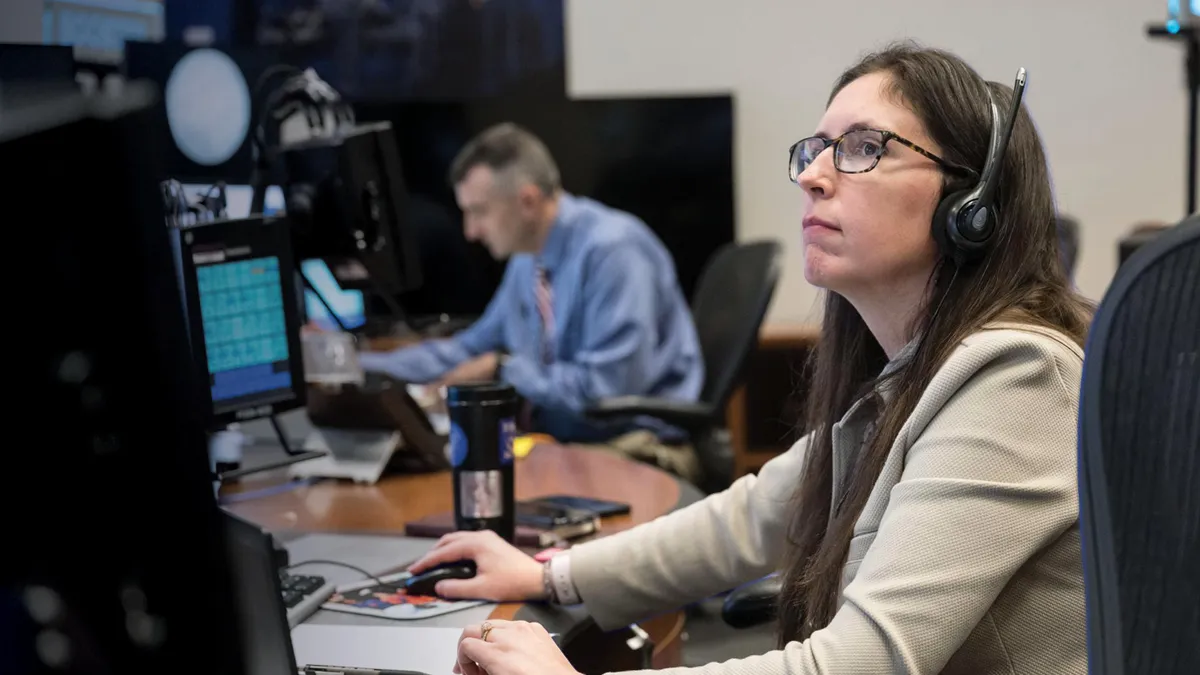
Yes. So yeah, science officer is a new console position in mission control and flight operations down at the Johnson Space Center. So we are a front-room position, which means that, like, main room in Mission Control—if you’ve ever seen any space movies, that’s the room you typically see. And it’s full of traditional engineering and other flight control disciplines, ultimately led by the flight director. And so for Artemis missions, starting with Artemis II, you know, I led the development of a new position called the "science officer," who is sitting in the front room and responsible for all of our lunar science and geology objectives.
Jenna Liberto:
So, take me into that room. What happens? What are you doing as we’re sending our astronauts to the Moon?
Kelsey Young:
It’s a room full of very smart and passionate people. It’s honestly, it’s one of my absolute favorite parts of the job, working with the flight operations community. You know, every single time I walk into that room, whether it be in the mission simulations—which we did many of leading up to the mission—or every single day during the mission, you get like a little jolt of excitement and, “Oh my gosh, I cannot believe I’m walking into this room to actually perform a function for the mission.”
So it’s just, you know, you sit down at your console, you pull up all the data streams you need, and our job is just to be that science representative—that science voice within flight operations—ultimately reporting up through the flight director. And in my case, [I was] super fortunate to get to talk to the crew a bit as well.
Jenna Liberto:
Yeah. Tell me about talking to the crew.
Kelsey Young:
Oh my gosh. I don’t even know what to say, which is ironic because that’s sort of the thing that I was tasked to do. No, I mean, it was just, it was honestly a dream come true. It’s a lot of pressure. Definitely, it was something that I took very seriously—took the weight of it very seriously—representing the lunar science community in that way. But, you know, the most impactful thing for me was that I had spent so much time with these crew members over years of developing our shared language and the common trust across our broader team.
And so it really felt normal in a very good way. Like, oh yeah, we’ve practiced this. We’ve been in the field together. We’ve hiked in the pouring rain and, you know, slept in a campsite, all together. And developing that language where they say a thing, and I really know what they mean because I was there with them, developing how they said words that indicated what they were seeing.
Jenna Liberto:
And again, for someone who doesn’t have a science background, what’s that data you’re trying to get from our astronauts?
Kelsey Young:
Yeah, from our crew members, we actually had kind of three main data types we were asking them to provide. One was images. They had three handheld Nikon cameras with three different zoom lenses that they could use to take images of specific targets we were asking them to image.
They gave verbal descriptions. So, they were recording descriptions of the lunar features we asked them to look at into their crew tablets. And then, also with the crew tablets, they were making sketches and annotations of what they were seeing. That was a technique that Apollo astronauts used in some cases that was really beneficial—to actually just sketch what they were seeing rather than describe it if there was a particular process or feature that warranted that kind of nuance.
The verbal descriptions, though, were really our highest-priority dataset because that’s what human beings are uniquely able to provide—describing the nuance that they see in color and albedo and as illumination conditions are changing across the surface. They’re capturing that live in a place on the lunar far side where we had never had human eyes before.
Jenna Liberto:
So, just so I get this right: When we’re talking about sending a crew to the Moon, of course we know there’s data—you want numbers. But you’re saying there’s such power in what they’re seeing, just what they’re observing and what they’re saying about it.
Kelsey Young:
Absolutely. It’s such a critical part of our objectives, honestly, to take advantage of . . . When I first got this role for Artemis II years ago, we started to think about like, really, how do we prioritize the science that we can accomplish with this mission? Science was not the driver for the mission. It’s a test flight.
It was the first time that that crew had flown this vehicle. But we really had the advantage of: this was a vantage point of the Moon that the Apollo astronauts did not have. They were much, much closer to the Moon, which has other advantages, but we had this full-disk view, this really unique opportunity. What is unique to Artemis II is the people. These are well-trained people who have spent years training to do this.
I can tell you as one of their trainers, you know, we really had to work with them for probably two years to say, "When you make these observations, when you say these words, here is what it means to us as scientists." Because I’ll be honest, at the start of this training process, they were skeptical. They were like, “I don’t understand how something I could say could influence something you take away from this.”
At one point, I think astronaut Christina Koch described something she was seeing as sort of looking like a lampshade with holes in it. OK, great. We know exactly what you’re seeing, and we’re able to drive out something about the scientific process that formed that landscape that she just described that way.
And so, are humans a replacement for orbiting spacecraft? Absolutely not. Are they really complementary and do they provide unique observations that we can’t get with orbiting spacecraft? Absolutely. And we’re getting now into—we have all the recordings, audio recordings that they made, plus what you heard live on the Orion-to-Earth loop. And I can tell you, there is absolutely scientific value in those descriptions. And because of the unique vantage point they had of this whole-disk view and the changing illumination that they had throughout the flyby, they’re able to provide this really unique dataset that’s super complementary to what LRO [Lunar Reconnaissance Orbiter] and other missions have done.
Jenna Liberto:
There’s this great video clip where you’re getting some of that data in real time from the crew, and your reaction is just ... I love your reaction because you can tell this is so cool. There’s that awe factor. Can you take me into that moment, and what were you getting that was striking you in that way that got that reaction?
Kelsey Young:
I held it together so well for the whole thing. I mean, it’s like seven hours of descriptions from them. I held it together until right at the very end, when we had them, you know, we had times where we bookcapped for them to look for impact flashes, which are new craters forming on the lunar surface. And it literally looks like a very brief flash of light, literally from something coming from space and impacting the surface of the Moon. And that was one of our highest-priority science objectives. And I didn’t think we would see any.
Jenna Liberto:
Really?
Kelsey Young:
Team members really did, especially the scientist who was responsible for that investigation of our whole set of science objectives. She apparently, when they said that they saw them, she jumped up and audibly screamed, which is great. I hope someone caught audio of that. I can’t audibly scream in the front room, but I did, what you saw on my face, that was genuine pure shock and incredulity that they actually saw not just one, but multiple.
Jenna Liberto:
And what does that tell you from a science perspective?
Kelsey Young:
So we have a lot of Earth-based efforts to look at the near side of the Moon to monitor these impact flashes. It’s relevant to help us characterize the lunar environment. Like, what are the dynamic processes taking place on or near the lunar surface? Also, scientifically, it tells us something about impact flux. But the fact that we had human beings looking at the far side at the time is not a measurement we would have been able to collect with anything else.
Jenna Liberto:
I want to talk a little bit about your time at Notre Dame. Is this when this dream that you’re now realizing started, or what can you tell me about that?
Kelsey Young:
It was literally my first semester of freshman year. I took the physical geology class, which is the entering class into that major, and like, literally one class, [I] was totally, totally hooked. It’s a really small department, but at the time there were two professors, in particular, that worked in planetary geology.
So, you know, field geology, looking at sites on Earth that look like sites on other planets to tell you something about how the solar system formed and evolved. One of those professors has since left, but another one, Clive Neal, is still here. And it was through them, honestly, learning from the two of them and taking their classes and doing field research with them, going on field trips as part of the degree—that truly developed not just my foundational base of knowledge from all the really important geology classes that you have to take, but also just this idea of planetary analogs and being able to do fieldwork on Earth that informs understanding of other planetary bodies.
Jenna Liberto:
How would you say Notre Dame uniquely prepared you for the career you’re in today?
Kelsey Young:
I think Notre Dame and the way that the program was integrated into the College of Engineering was really critical for me to look at science as a broad interdisciplinary thing rather than a unique silo. I also think, you know, having these two professors—you’re integrated with them, right? It’s a small major. You’re a really tight-knit group, and you’re really helping—they really helped mentor me to understand that this was even a possibility. I think also just the opportunities that the department provided to me were really foundational. The spring break geology trips, you had to take two of them to graduate with the major.
Honestly, doing that fieldwork really helped me understand that this was possible for a career. I have been to the same sites as a professional field geologist for NASA that I was introduced to on these field trips. And they funded us to go to field camp, which is a fundamental part of a field geologist's education. And so, the support that the department provided to go on these pretty unique and foundational experiences ultimately built the base and let me know that planetary analog fieldwork was even a field that existed.
Jenna Liberto:
And now a little bit of a full-circle moment tonight and tomorrow when you’ll be meeting with students having their undergraduate experience right now. What do you want them to take from your story?
Kelsey Young:
I think it’s—this is probably very cliché, but I really believe in it. I mean, it’s choosing your own journey, following your own path, and not being scared if no one’s walked the path before you. There is power and grace in that, and it really helps develop your sense of confidence and purpose. And knowing that not every path is linear.
You take paths less traveled, and you’re going to have some false starts, and that’s, you know, part of it. And having the confidence to kind of just push through and know that what you are passionate about is something that you can pursue, even if there’s not a logical path to do it. You know, for me, it started here.
Jenna Liberto:
You told me off-camera you had “bring your kids to work” day. So there’s some real-life stuff in the midst of it all. What’s that like, bringing your very young daughters into a space you work in every day?
Kelsey Young:
Ah, yes. My kids were young enough that I just hadn’t taken them to “take your kid to work” day yet, so I took them last week. They’re 2 and 4. The 2-year-old’s just like a chaos gremlin, like running everywhere. But the 4-year-old, I think, was really into seeing—like, we got to see the Nancy Grace Roman Space Telescope in the clean room. She thought that was really impressive. She didn’t understand why they were wearing, like, the white bunny suits; she had a lot of questions about the logistics of that.
But it was just really great, right on the heels of such a foundational experience for me, and, you know—after the three weeks I had to spend away from my family and my kids—to be able to bring them along for the ride a little bit. And [I’m] really grateful to my husband, as well, who held down the fort with a 2-year-old and a 4-year-old, who also graduated here from Notre Dame and is right now wandering the campus.
Jenna Liberto:
And that’s a mission, isn’t it?
Kelsey Young:
That’s right.
Jenna Liberto:
That’s a mission in and of itself at home. And so, what’s next for you?
Kelsey Young:
We have a lot of data from the mission to analyze.
Jenna Liberto:
You still have work to do.
Kelsey Young:
So much work to do. So much work to do. So yeah, I mean, it’s a six-month, pretty aggressive push to get all of the data publicly available, to write up the reports so that the public can get their hands on the data and start to analyze it themselves. And then we also have three new missions that we’re planning for right now. So I’ve been in many meetings since Artemis II ended about Artemis III, IV, and V.