Sowing seeds of hope: Vatican partnership advances global sustainability
The collaboration supports research, education, and action to build a more just, sustainable future.


The Borgo Laudato Si’ represents the next chapter in a long and storied history. Nestled in the scenic hills of Castel Gandolfo, southeast of Rome, the estate traces its origins to the imperial age: Here, in the first century AD, Emperor Domitian built an imperial residence. And from the 17th century onward, the area became part of the patrimony of the Papal States, eventually serving as the summer residence of the popes.
The idyllic setting spans 135 acres and features the picturesque, Renaissance-era Villa Barberini, extensive terraced and manicured gardens, historic Roman ruins, and a thriving farm, all overlooking the blue waters of Lake Albano.
From the time of the Emperor Domitian to the papacy of Pope Benedict XVI, this location provided a quiet refuge to study, rest, and reflect and a respite from the Rome heat.


The Borgo Laudato Si’ is located in the scenic hills of Castel Gandolfo, southeast of Rome.
But the late Pope Francis saw the property in a different light.
Following his 2015 encyclical Laudato si’—a global call to action to care for the Earth and protect those most vulnerable to the effects of environmental degradation—Pope Francis envisioned the Borgo as a place where the principles of Laudato si’ could be put into action.
On February 2, 2023, he founded the Laudato Si’ Higher Education Center to begin transforming the gardens of Villa Barberini and the Pontifical Villas into a place of training in integral ecology—a framework that seeks to care for both nature and the most vulnerable among us.
“He said, ‘Let’s create an educational center here, but also a spiritual center,‘” said Rev. Daniel Groody, C.S.C., the vice president and associate provost for undergraduate education and professor of theology and global affairs at Notre Dame. “Here’s a place to encounter the beauty of nature that God has created—and a place that can facilitate an ecological conversion.”
Pope Leo XIV, who has likewise emphasized sustainability as one of his major priorities, dedicated the Borgo Laudato Si’ last fall, calling it “a seed of hope” that promises to bear the fruits of justice and peace.
As the Vatican seeks to bring Pope Francis’s vision to life, it has asked the University of Notre Dame—an institution that has also sought to enact the principles of Laudato si’ in its teaching, research, and operations—to serve as an academic partner.

A long-term partnership with Notre Dame was ideal, said Sister Alessandra Smerilli, F.M.A., secretary of the Vatican’s Dicastery for Promoting Integral Human Development, not only because of the depth and breadth of its research and teaching on sustainability, but also because its mission aligns closely with the Church’s teachings to care for our common home and for the marginalized.
“From the very beginning, we said that this is the right partnership, because Notre Dame can bring expertise and professionalism, but also because it shares with us passion and Catholic values,” said Sister Smerilli, who is also a member of the board of directors of the Laudato Si’ Higher Education Center. “And that is what the project needs in order to be even more effective.
“The Borgo Laudato Si’ has a strong educational vocation and, when we started, we understood that also in the field of education—just as in every other part of our project—it was necessary to rely on an outstanding-level partner in order to offer the very best to students and trainers, in terms of how to live a transformative experience based on Laudato si’ and integral ecology.”
Achieving the vision of Laudato si’
Together, the Vatican and Notre Dame have launched the Global Alliance for Laudato Si’, an international network dedicated to supporting integral ecology and global sustainability. The Global Alliance aims to strengthen cooperation among universities worldwide and connect sustainability leaders in academia and beyond to advance a shared vision for transformative change. Responding to Pope Francis’s call to “hear both the cry of the earth and the cry of the poor,” the partners hope their combined efforts will effectively address global environmental degradation, inequality, and ecological injustice.
Formally launched during its inaugural convening at the Borgo in March, the alliance will serve as a hub for connecting, amplifying, and spearheading research, curriculum, and action initiatives for a sustainable future.
The two-day event brought together nearly 100 scholars from more than 60 institutions and 30 countries around the world, who were joined by Vatican leaders including Sister Smerilli and Cardinal Fabio Baggio, C.S., the undersecretary of the Dicastery for Promoting Integral Human Development and director general of the Laudato Si’ Higher Education Center.

 Notre Dame and the Vatican Launch Global Alliance for Laudato Si'
Nearly 100 scholars from more than 60 institutions and 30 countries around the world were joined by Vatican leaders to launch the Global Alliance for Laudato Si’. Watch the video to learn more about what they accomplished.
Along with Rev. Robert A. Dowd, C.S.C., president of Notre Dame; John McGreevy, the Charles and Jill Fischer Provost of the University; and Father Groody, several Notre Dame faculty and administrators attended the event, which was co-organized by Cardinal Baggio and Arun Agrawal, the Pulte Family Professor of Development Policy in the Keough School of Global Affairs and inaugural director of the Just Transformations to Sustainability (JTS) Initiative at Notre Dame.
“Since Laudato si’ came out in 2015, millions of people around the world have been working to advance the vision that Pope Francis had,” Agrawal said. “But many of these efforts are in isolation from each other. Many are operating without sufficient resources. Many are encountering challenges that run counter to both what Pope Francis was imagining as the different world we would live in and the processes that would lead us there.
“The goal of the Global Alliance—which was an idea and a term created by Cardinal Fabio Baggio—is to build connections across these different efforts to advance Laudato si’. Our goal is not to replace what these efforts are doing, but to support them, to learn from them so that we can leverage what has already been done into an even stronger effort to achieve the vision of Laudato si’.”
The group emerged from the first convening with a defined research and action agenda, established working groups, and, most importantly, “a renewed sense of purpose and hope,” Father Dowd said.
“These interdisciplinary research and education initiatives reflect our commitment to an integral ecology that recognizes the deep connections between environmental sustainability and human dignity and flourishing,” he said. “We look forward to the many ways this collaboration will serve the common good and advance care for our common home in the days ahead.”
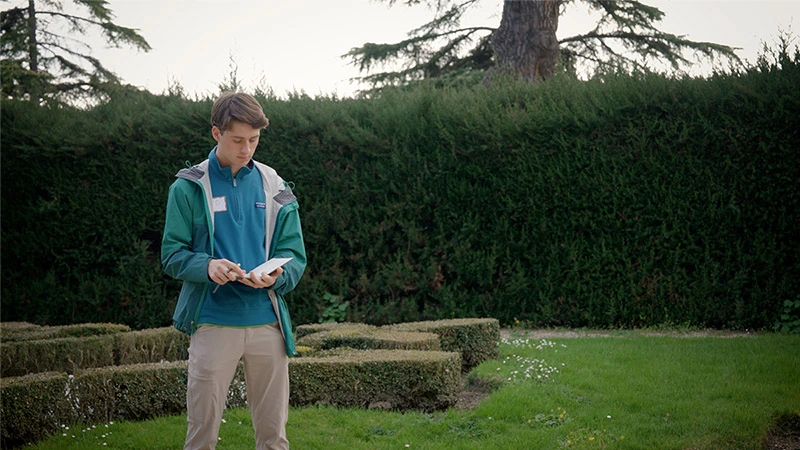
In addition to the Global Alliance, Notre Dame and the Vatican are developing immersive learning experiences for students to be held at the Borgo Laudato Si’. Developed in partnership with Notre Dame’s JTS Initiative, Institute for Educational Initiatives, and Office of Undergraduate Education, these courses will provide training in the interconnected environmental, social, and economic dimensions of sustainability.
A pilot course was held at the Borgo in March, and a one-week summer course, taught by Agrawal and Father Groody, who is also a member of the board of directors for the Laudato Si’ Higher Education Center, will be offered for the first time in May.
 Creating a sustainable future
“We’ve developed this curriculum with the help of many people at Notre Dame to pilot at the Borgo, but we believe it can also be something very powerful that will be used to educate people around the world,” Father Groody said. “We’ve also been thrilled to see that there are many other areas of the University, including the Keough School of Global Affairs and the School of Architecture, that have become a great asset to the Borgo as they develop additional programs and develop the infrastructure of this great place.”
Strengthening sustainability research
The Vatican partnerships are led by the Office of the Provost, including the Office of Undergraduate Education and the JTS Initiative, which was launched last fall as part of the University’s strategic framework. The initiative brings together scholars from across the University with global partners to advance solutions for a more just and sustainable future.
It also builds on the work Notre Dame has conducted on sustainability for more than a decade, Provost McGreevy noted—work that is ongoing in nearly every college, school, center, and institute at the University.


Notre Dame biologists are examining freshwater ecosystems in order to protect and restore streams, wetlands, and lakes. Architecture and engineering scholars are focused on how to foster a more sustainable built environment and improve living conditions, particularly for residents of low-income neighborhoods. Historians are investigating the origins of climate change. And in 2022, Rev. Emmanuel Katongole, a professor of theology and peace studies, cofounded the Bethany Land Institute—a two-year residential agricultural institute teaching integral ecology in Uganda.
“Notre Dame has been engaged in sustainability research and education for many years across a wide range of disciplines, with important work already underway in many areas,” McGreevy said. “The Just Transformations to Sustainability Initiative allows us to build on that foundation—bringing this work into closer conversation, strengthening partnerships, and extending the reach of our scholarship.”

To advance that collaboration, dozens of Notre Dame faculty members and administrators joined leaders from the Church, other universities, and prominent sustainability organizations at the initiative’s inaugural sustainability summit at Notre Dame Rome, just after the launch of the Global Alliance.
In addition to global partnerships, JTS is also working to strengthen regional collaboration through initiatives such as the Midwest Sustainability Platform for Research and Curricular Innovation. The platform brings together leading universities across the Midwest to address challenges specific to the region, including climate impacts, agricultural sustainability, and energy transitions.
Locally, JTS is leveraging existing partnerships across Notre Dame’s campus, with colleges, schools, and research centers and institutes including ND Energy, the Environmental Change Initiative, and the Eck Institute for Global Health.
The JTS Initiative aims to create a different way of thinking about sustainability that is informed by the University’s Catholic character, Agrawal said.
“We want to approach this in such a way that our vision of sustainability—which is about hope, which is about making a difference in the world, which is about bringing people together—becomes common knowledge,” he said.

“We want to do things together with others. We want sustainability not to be equated with the problems that we are facing, but to be synonymous with a vision of the future that makes things better for the people and the planet.”
As the JTS Initiative works with the Vatican and other partners to build that vision of the future, Agrawal said he can imagine no work that is more important—or more challenging.
That’s precisely why he believes Notre Dame is uniquely suited to tackle it.
“I think Notre Dame is the right place to initiate this because we don’t shirk challenges,” Agrawal said. “We don’t decide not to do something because it’s difficult. We do things because it’s the right thing to do.
“At Notre Dame, we do things because it is aligned with our mission, with our understanding of our role in the world, and with our call to care for our common home as we build out a more just and humane society.”
Learn more about Notre Dame's sustainability efforts on campus.