Fighting for second chances

Through Notre Dame’s Inspired Leadership Initiative, Marty Whalen turned a second act into second chances for formerly incarcerated people.

Marty Whalen sold a family office supply business in northern Illinois and decided to return to campus through the Inspired Leadership Initiative to discern his next act. He thought he might take calculus to redeem his poor grade from his days at Notre Dame in the 1970s.
Instead, he decided he didn’t need to prove anything, and took classes that interested him, including restorative justice.
A visit with a friend in prison spurred him to get involved at the Moreau College Initiative and Westville Correctional Facility by proctoring study halls, which, ironically, led to teaching algebra. His wife, Kathleen, joined in by teaching yoga there.
“The Notre Dame ecosystem was eye-opening,” Whalen said. “We had a day where we met two people that had Nobel Prizes, and Senator Joe Donnelly came to speak to us, and you just don’t get those experiences selling copiers.
“I don’t think it awakened anything in me, but it sure put a fine point on what life can be if you’re very curious.”
Whalen and another Moreau teacher started a business in South Bend that makes solar panels and employs only people who were formerly incarcerated. They provide opportunities that are out of reach for most former felons, who struggle to find their own second acts in a country that incarcerates more people than any other in the world.
“Our business doesn’t exist only to make solar panels,” Whalen said. “Our business exists to pay a living wage to people reentering society after incarceration.”


The Inspired Leadership Initiative (ILI) fellowship gives “accomplished individuals”—usually older and often retired, only some of whom have University connections—an opportunity to come to campus and audit classes for a year. Some courses are tailored just for them, such as a core life design class, while the rest of the curriculum means being thrown into classrooms with undergraduate students, often with surprising results, according to program director John Duffy.
“We get these accomplished people who come to Notre Dame and spend a year here in discernment,” Duffy said. “Many of them leave with the idea that their second act should be defined by something that promotes the common good. What Marty wound up doing is a great example of that.”
Duffy also said the ILI experience fits Notre Dame’s mission because the fellows explore personal transformation as they consider how to become a force for good in the world.
“It’s about giving people the opportunity to reflect, to discern, and to decide what is it that they want to do with the rest of their lives in ways that are meaningful for them,” he said.
Duffy was introduced by accident to the program he now runs when an older man knocked on his office door and asked if he could attend an English class that discusses race relations in the country, always a touchy subject. Duffy was not enthusiastic. Yet by the end, he realized the students “cherished” the older man’s presence, as did he.
“The class was better because he was in it, and the reason for that was, he would ask questions I didn’t think to ask, and he knew things I didn’t know,” Duffy said. “And that was my introduction—that this is good for our undergraduate students.”


Whalen’s journey from retirement to employing formerly incarcerated people
After Whalen graduated from Notre Dame in 1982 with a sociology degree, he returned to the south Chicago suburbs to work in a family business that sells business supplies, from copiers to office furniture. He later ran that business until there was an opportunity to sell it when he was still in his 50s, finding himself an early retiree.
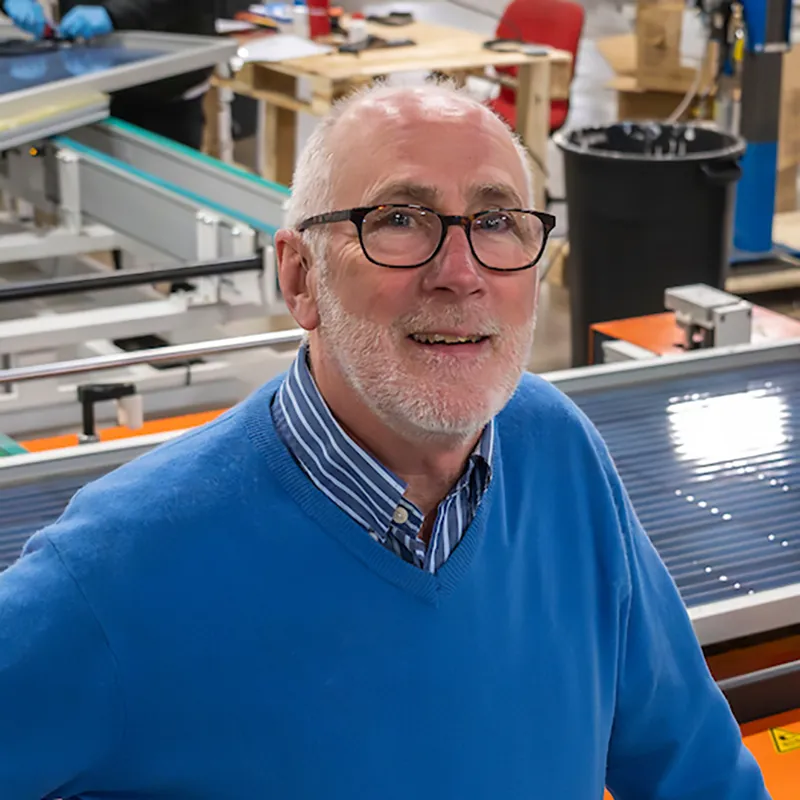
The initial plan was to buy a Sprinter van and travel the country, visiting his and Kathleen’s four children at different colleges. Then Kathleen read a story about the new ILI fellowship Notre Dame was starting in 2018, similar to programs for older adults run by Harvard and Stanford universities.
Marty Whalen was part of the first ILI cohort. He and Kathleen found that volunteering at Westville prison was a central part of their experience.
“It’s really a solitary thing,” he said about Westville. “You go through the shakedown process every time, and then you walk to your classroom and you teach, and you leave the same way.”
After his ILI year, Whalen took a job as the career program manager for Notre Dame’s College of Arts & Letters. His job was to develop programs to help students connect with available career options. He continued to volunteer at Westville, where he was asked to create an internship program for final-year students. The task is a challenge because the men can’t leave the facility.
In this capacity, Whalen was approached by Patrick Regan, a now retired political science professor at Notre Dame who also taught at Westville through the Moreau program. Regan had experienced a wake-up moment in a prison class that reshaped his future.
“I was extolling the virtues of a college education to 25 men full of tattoos and in jumpsuits,” Regan said. “I said the world opens up to you, but it didn’t open up to them. And one of them raised his hand and he says, ‘The problem is, professor, your people won’t hire us.’”
‘The problem is, professor, your people won’t hire us.’
So Regan, who wrote a book about the politics of climate change, came up with a business idea that could pay decent wages to formerly incarcerated people. He hoped that Whalen, as the Moreau internship leader, could help him locate the former Moreau students to hire.
Everyone else Regan had shared his fledgling business plan with told him not to ruin his retirement. Whalen took it seriously, even though the ILI friends he showed it to thought the idea was would be challenging.
“Pat posited this idea of a 21st-century business, something that was reasonably high-tech, that paid a living wage to formerly incarcerated people and could help them up the ladder of economic security and to rejoin society as tax-paying members,” Whalen said.
Whalen walked into the meeting with the business plan already marked up with suggestions. Regan did not know Whalen’s background; he was just glad someone was validating his plan.
“At the end of the meeting, Marty said, ‘I just really love this idea—this is the best thing I’ve seen in a while, and my family’s been fortunate and we have the funds to make this happen,’” Regan said.
Floored, Regan accepted a check to get the company started.
Building a start-up: Crossroads Solar
Whalen and Regan made the decision to start the company in 2019. Regan went to China that December to find the machinery to make the solar panels, and the assembly line began to arrive in June, right after the COVID-19 pandemic shut down the world.
The Chinese engineers who were supposed to train them on how to make solar panels could not travel to America. Regan asked his friend Paul Brenner, the interim director of the Center for Research Computing, to send two undergraduate electrical engineers and a mechanical engineer to lay out the flow of an assembly line for production. Luckily, Whalen was mentoring a College of Arts & Letters student from China, and he asked her to come translate.
“All of the interfaces were in Chinese,” Whalen said. “We didn’t even see the word for start. So we couldn’t turn it on without some help.”


The company began making test panels despite lacking a designation as essential workers during COVID. Regan’s son helped with the materials supply chain and his daughter dove into social media. Whalen had moved to Montana during the pandemic, but he and some of his children showed up to help make panels.
The story of the company’s first customer reveals the challenge of creating a company without any experience. At an outdoor concert in Elkhart, Regan saw a marketing stand for another solar company. He approached a man who was disappointed that the competitor wouldn’t sell the panels without installation included.
Regan persuaded him to buy Crossroads’ early practice panels, but he didn’t have a way to provide a receipt for the man’s deposit. He improvised on a legal pad, but forgot to keep a copy and didn’t have the man’s phone number. Luckily, the man called back and got his 28 panels.
Early on, the company also learned about supply chains and global trade. They had to shut down for two weeks when a tanker got stuck in the Suez canal, blocking ship traffic in 2021. President Donald Trump’s tariffs on foreign goods has dramatically increased their supply costs.
“Most people don’t understand how the money’s collected, but as somebody who’s actually paying it, you know exactly when and how it’s collected,” Regan said. “When the product reaches the port, the shipping company won’t take it until we pay the tariff.”
Now that the Supreme Court ruled against the tariffs in February, Regan and Whalen hope Crossroads will receive a substantial refund, a windfall for the small company.
Creating jobs for formerly incarcerated people in Indiana
Early on, Crossroads’ founders estimated that the company needed to make 60 solar panels a day to stay in business, yet the first six employees struggled to produce four. Crossroads was able to boost its production to 12 panels a day but still wasn’t close to surviving.
“I didn’t know anything about production equipment,” Regan said. “I was an academic. I live in this little bubble of a world, my wife would say.”
That’s when Regan hired Noel Townsend, a former student of his at Westville prison who also had an industrial engineering degree from Purdue University and experience in commercial production. Instead of jumping on the floor to help like Regan and Whalen, Townsend studied the process, found the flaws, and came up with solutions to produce 60 panels a day.
“Being able to help my fellow comrades in incarceration, it’s fulfilling,” said Townsend, the company’s operations manager. “We help these men and women become productive citizens again.”
One shining example is Bianca Spears, who has worked at Crossroads for more than two years. After being convicted of a felony and spending a year in county jail, Spears said her job opportunities were limited to low-paying service positions. But Crossroads was different and “refreshing” because her past is accepted there.


“The job market is very, very small for felons,” Spears said. “Crossroads is a really good place to be for people who have things on their records or are coming out of incarceration. It feels like home.”
Spears said she liked that the company makes a product that is good for the environment and that it feels like a family atmosphere where everyone is working toward a common goal.
“I like to think of it as a bunch of imperfect people, who have made mistakes, coming together,” Spears said. “They’re able to support their families. They’re able to have confidence and hope because they don’t have to hide or be ashamed of what they’ve done.”
Since being there, Spears has enrolled in school and has completed her second semester at Ivy Tech Community College. She has already progressed from being a production line worker to logistics and fulfillment, responsible for inspecting every panel going out to ensure each is flawless. When her degree is in hand, she wants to become a production supervisor.
“Crossroads made me find my niche,” she said.
The power of second acts
Crossroads was born of two idealistic partners flailing their way through second acts in order to provide good jobs for people they believe deserve a second chance. Both said positive experiences at Westville motivated them to ameliorate the negative effects of a flawed justice system. “We as taxpayers should demand a lot more,” Whalen said.
Both also expressed the satisfaction they derive from seeing the employees succeed. Their stories make the effort worthwhile. Whalen spoke of a man from Gary, Indiana, who couldn’t believe his family now speaks of him as someone for the younger generation to emulate.
Regan said he also appreciated the worldly experience Whalen brought to the business. Once when he couldn’t figure out from Quickbooks how much money the company had or owed, Whalen jumped in his truck and drove from Montana to walk him through the financials.


Whalen said he’s proud of what the company has accomplished. It now makes up to 400 solar panels a day and employs about 45 people in its factory on the west side of South Bend. One glance at the factory floor confirms Whalen’s claim that employment is the company’s primary purpose—one assembly line is fully automated, but the other is mostly manual, by choice.
“Without ILI, I never get the opportunity, probably, to go talk to another professor (Regan) and start that company,” Whalen said. “That just opened up a world that was unusual for me, for being from a small town in Illinois.”
Duffy, the ILI director, said what distinguishes Notre Dame’s program from similar adult programs is that it focuses less on what a graduate will do than who they will become. “We don’t have a presentation about your big plan at the end,” Duffy said. “With us, it’s more about personal exploration.”
Whalen’s second-act plan took a few years to come to fruition. Maybe that’s because it was less about what he wanted to accomplish than who he wanted to help.
Bianca Spears said she fits the bill, coming from incarceration with her head down, but then finding a place where she could put the past behind her.
“Let’s go, we can have a new start,” Spears said. “You can make good money. You can build nice working relationships, and you can do something great for the environment.
“I can’t imagine working anywhere else.”